> For the complete documentation index, see [llms.txt](https://docs.sentiance.com/llms.txt). Markdown versions of documentation pages are available by appending `.md` to page URLs; this page is available as [Markdown](https://docs.sentiance.com/getting-started/features-catalog/driving-insights.md).
# Driving Insights
Learn how to understand your driving behavior and uncover insights to improve safety, efficiency, and overall performance.
## Introduction to Driving Insights
Sentiance's Driving Insights is an advanced telematics solution designed to analyze driving behavior directly on users' smartphones.
By leveraging smartphone sensor data, this technology provides real-time feedback on driving patterns, risky behaviors, and overall safety on the road without transmitting personal information off the device, ensuring user privacy.
## Features Overview
{% hint style="success" %}
All of these features and functionalities depend on the users movement and data collection by the SDK.
{% endhint %}
{% stepper %}
{% step %}
#### **Driving details**
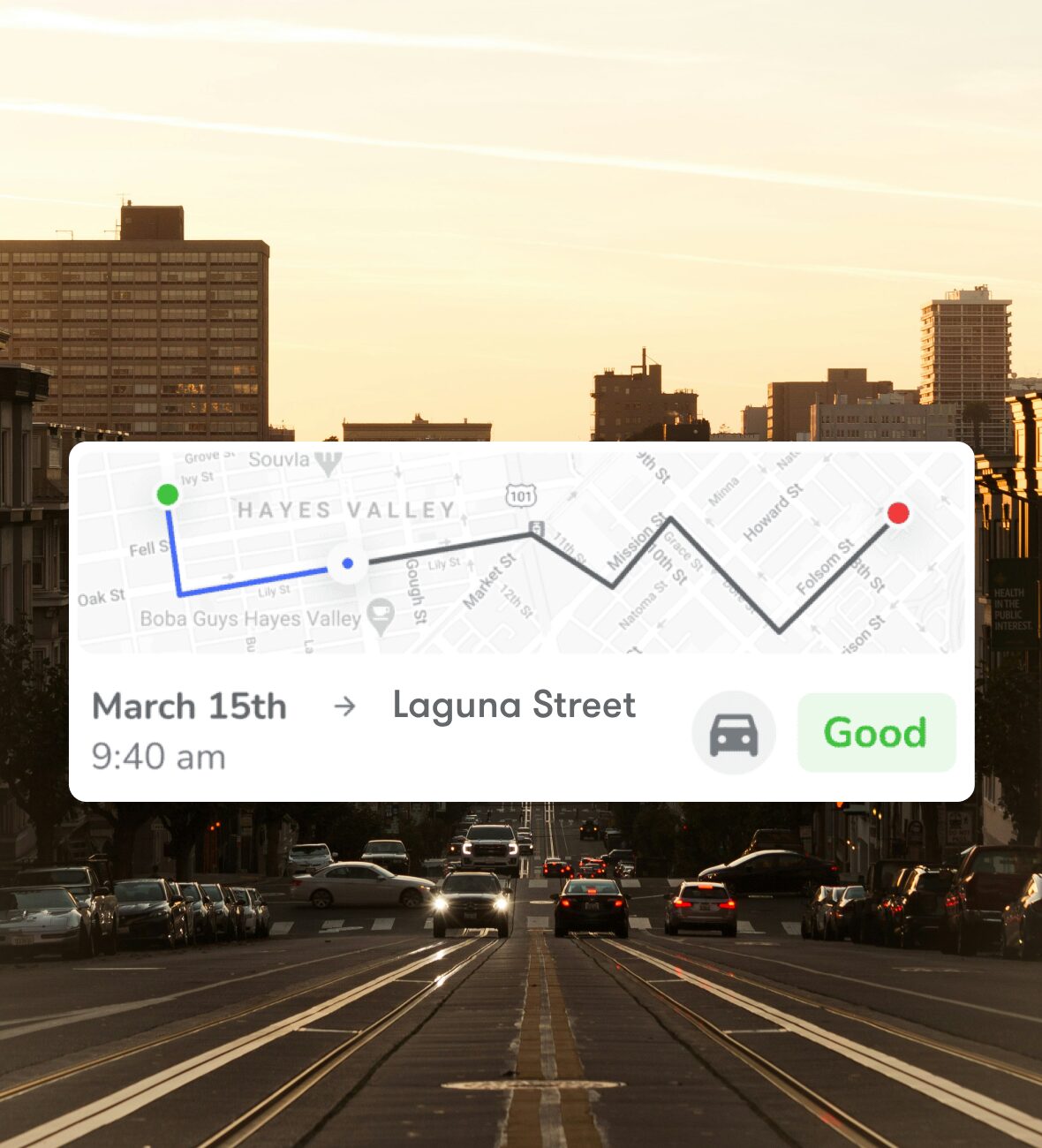
Includes information such as time of day, trip duration, distance, and a full record of the route taken, based on GPS waypoints. including the mode of transport.\
Find full list of driving details below.
Driving details
* **Time**\
Start and end time of the driving event.
* **Duration**\
Time in minutes that the driving event took
* **Distance**\
the total distance in kilometers
* **Complete trajectory**\
complete collection of the route that the user took based on the GPS waypoints
* **Transport mode**\
determines what type of mode the user used to transport from A to B\
This can be one of the following modes:
* Car,
* Motorcycle,
* Bicycle
* **Driver role**\
indicates the role of the user, was this user the Driver or a Passenger
{% endstep %}
{% step %}
#### **Driving events**
Events collected during a trip are determined by driver behavior and vehicle motion. These events provide insights into driving patterns, form the basis for driving scores, and include additional relevant information. See below for the types of driving events that can be triggered.
Driving events
* **Harsh events:**
1. **Turning**
This refers to the force that pushes a car to the side when making a sharp turn. It's the feeling of being pushed to the side in your seat as the car takes a curve quickly.
2. **Braking**
This refers to a sudden decrease in speed or a "hard brake" when driving a vehicle. It's like stepping on the brakes abruptly, causing the car to slow down quickly.
3. **Accelerating**
This refers to a sudden increase in speed or a "hard acceleration" when driving a vehicle. It's like stepping on the gas pedal quickly, causing the car to speed up rapidly.
* **Speeding event**\
Measures adherence to speed limits by detecting when the driver surpasses speed limit of the road they are driving on. By default a 5 km/h buffer is applied.
* **Phone usage event**\
Events predicted using ML models to detect active phone handling while driving
* **Call Event**\
Indicates instances when any type(phone, whatsapp, facebook) of call was made during driving.
* **Wrong Way Driving event**\
Indicates an instance when a driver has driven in the wrong direction in a one-way street.
{% endstep %}
{% step %}
#### **Driving scores**
The driving events are used to generate scores for the trip. These scores consist of multiple sub-scores that reflect different aspects of driving performance.\
See below for what type of scores can be generated and what they mean
Driving scores
Our platform uses a flexible scoring system that combines raw events, applies thresholds, and normalizes results at both trip and population levels.
When you start using the platform, you’ll receive a set of default scores. These have been optimized to be broadly applicable and practical.
* **Overall**\
Aggregated and averaged score calculated from all scores recorded for a driver over a period of time(7, 14 or 30 days)
* **Smooth**\
The smooth driving score measures how smoothly you drive. High accelerations, heavy braking, and heavy turning result in a lower score.
* **Legal**\
The legal driving score measures how well you adhere to speed limits. The higher your score, the more you respect the speed limits.
* **Focus**\
The proportion of time that the user is focused while driving, being focused means: not using the phone.
* **Attention**\
This score combines phone calls and phone usages during driving to determine attentiveness.
* **Call While Moving**\
Scores the proportion of time that the user is on a call while driving their car at higher speeds.
{% endstep %}
{% endstepper %}
### Additional notes
* The SDK requires sufficient detection data to process and provide reliable insights. transports of at least 3 minutes in duration and/or 2 km (1.2 miles) in distance provide most accurate driving insights